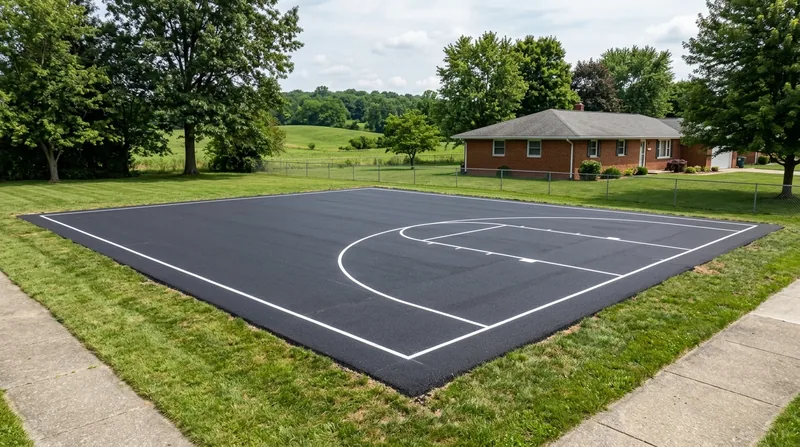




Mansfield's ranch-belt neighborhoods spread across quarter-acre lots where the glaciated plain flattens out, and those yards often have room for a backyard court or recreational path. A sports court and path paving project here means grading a stable, well-drained pad despite the rolling terrain nearby, then laying hot mix asphalt pitched just enough to shed rain without pooling. The freeze-thaw cycles that dominate Mansfield winters and roughly 40 inches of annual precipitation make drainage and proper base prep essential: water that pools on a court surface will crack and heave within a season, and a poorly graded pad under a path will develop ruts and washout. We grade and compact the base, set the crown, and pave a durable surface that handles winter and stays playable year-round. Whether you're building a basketball or tennis court for family use or a walking path that ties together your yard, the foundation is everything, and that's where we start.
Why Proper Grading and Drainage Matter for Backyard Courts in Mansfield
Mansfield sits where the glaciated plain meets the Allegheny Plateau, and that terrain creates both opportunity and challenge for backyard courts. The quarter-acre ranch-belt lots that dominate the mid-century neighborhoods have enough space for a flat recreational pad, but the surrounding ground slopes, and water that doesn't drain properly will destroy the surface within one or two winters. A court or path needs a stable base compacted to proper density, a slight crown or pitch to direct water away, and aggregate beneath that allows drainage instead of trapping moisture.
- We excavate and remove unstable topsoil, exposing the glacial till and stone base beneath.
- We compact the subgrade and lay a thick, well-graded aggregate base to handle freeze-thaw stress.
- We pitch the surface to shed water away from the court or path without creating visible slopes.
- We pave hot mix asphalt in two courses, binder and surface, for durability and playability.
A court built on a poor or poorly drained base will crack, heave, and develop ruts within a few seasons, turning a capital investment into a liability. Proper grading is the difference between a court that plays well for a decade and one that fails in two years.
Local example: A homeowner in Mansfield's Eastwood neighborhood wanted a half-court basketball pad on a sloping lot. We graded the pad level, compacted a 6-inch aggregate base, and pitched the surface to drain toward a swale on the downhill side. The court has been playable and crack-free for five years, and the pitch is so subtle you don't notice it underfoot. A cheaper install without proper base work would have heaved and cracked by now.
How We Build a Sports Court or Path in Mansfield: Site Prep to Paving
A court or path paving job starts with a site visit to understand the slope, soil, drainage, and intended use. We measure the area, assess the base conditions, and plan the grade and pitch so water runs off and the surface stays stable through winter. The work moves in clear stages, each one critical to the final result.
- We mark out the pad, set grade stakes, and excavate to remove topsoil and unstable material.
- We compact the subgrade, proof-roll it to check for soft spots, and correct any low areas.
- We lay and compact an aggregate base, typically 4 to 6 inches depending on soil and expected use.
- We set up a paving operation, heat the asphalt, and lay the binder course in one lift.
- We finish with a surface course, roll it for density, and allow it to cure before use.
Each step builds on the last, and cutting corners in base prep or compaction will show up as failure within a few years. We take the time to do it right.
Concrete example: A property manager in Ontario asked us to pave a 2,500-square-foot walking path connecting two buildings on a sloped site. We graded the path to follow the natural slope, pitched it to drain to a swale, compacted a 5-inch base, and paved 2 inches of hot mix. The path sheds water immediately after rain and has held up through two winters without cracking or rutting. See our gravel driveway and grading page for more on base prep and drainage.
Methods: Court and Path Paving Approaches
| Approach | Description | Best for |
|---|---|---|
| Full grading and asphalt pad | Excavate, compact base, lay hot mix in two courses on a new site or over failed surface. | New courts, paths on sloped or uneven ground, or replacement of failed pavement. |
| Overlay on existing pad | Lay a new surface course over a sound base that is slightly worn but structurally intact. | Refreshing a court or path that is 10-15 years old and has minor surface wear. |
| Milling and repaving | Remove the top 2-3 inches of failed asphalt, compact the remaining base, and pave a new surface. | Courts or paths with moderate cracking or rutting but a stable base underneath. |
| Recycled asphalt millings pad | Grade and compact recycled asphalt millings for a lower-cost recreational surface. | Budget-conscious paths, informal courts, or temporary recreational areas. |
| Tar and chip surface | Lay a chip-sealed surface over a graded base, a middle ground between asphalt and millings. | Rural properties, low-traffic paths, or owners seeking a softer surface than hot mix. |
Sports Court and Path Paving Cost in Mansfield: What to Expect
A sports court and path paving project in Mansfield typically starts at $8,500 for a modest 1,200-square-foot pad with straightforward grading and a two-course asphalt install. The cost moves up based on several concrete factors: the size of the pad, the slope and soil conditions on your lot, how much excavation and base work the site requires, access for equipment, and whether you're paving a new pad or replacing a failed one. A sloped lot in Mansfield's hillside neighborhoods may need more grading and base material than a flat ranch-belt pad, and that drives cost. A path on difficult terrain with poor drainage will cost more than the same square footage on level ground with good soil.
We always recommend getting written estimates from two or three contractors so you can compare scope, tonnage, and price. An honest estimate will spell out the base thickness, the asphalt weight per square yard, the number of courses, and any site-specific work like drainage or grading. If one estimate is dramatically lower than the others, ask why: it may mean thinner base, fewer asphalt courses, or skipped site prep. See our full pricing page for detailed breakdowns and cost factors.
Timing also affects cost. Spring and fall are the busiest seasons for paving in Mansfield because the freeze-thaw cycles in winter are hardest on new asphalt, and summer heat can make laying asphalt challenging. If you can schedule work in May, September, or October, you'll get faster turnaround and may avoid surcharges. Emergency or rush work in winter costs more because of weather risk and crew availability.
Sports Court and Path Paving Near Me: What Mansfield Homeowners Should Know When Hiring
Finding a trustworthy paving contractor in Mansfield or nearby towns like Lexington, Shelby, or Ontario means understanding what to look for and what questions to ask. The paving trade attracts legitimate local operators and also itinerant crews that pitch unsolicited door-to-door, offer to use leftover asphalt from a job nearby, and disappear if problems arise. You protect yourself by verifying the contractor's credentials, getting everything in writing, and checking references from recent local work.
Start by confirming that any contractor you consider is fully insured and can provide a current certificate of insurance. In Ohio, paving itself is not licensed by the state, but the City of Mansfield and other municipalities in the region may require contractor registration or permits, so ask your local building department what applies to your project. A contractor who is vague about permits or claims none are needed is a red flag. Get a written estimate that includes the pad size, the base thickness and material, the asphalt weight per square yard, the number of courses, and a firm price. Avoid any contractor who quotes only a total without breaking down the work.
Ask for references from court or path jobs completed in Mansfield or nearby within the last two to three years, and call at least two. A legitimate contractor will have no trouble providing them. Check whether the work has held up without excessive cracking or rutting, and whether the contractor was responsive if issues came up. If you have an HOA, check your architectural standards to see if there are restrictions on court materials, colors, or placement. Call our office at (419) 775-9330 for a free estimate and to discuss your site and goals. We'll walk you through the options and give you a realistic price and timeline.
Sports Court & Path Paving in Mansfield: Pricing Guide
| Service | Price | Details |
|---|---|---|
| Small backyard court or path, 1,000-1,500 sq ft | Starting at $8,500 | Includes excavation, base compaction, 4-inch aggregate, 2-course asphalt on level or gently sloped ground. |
| Medium court or path, 1,500-2,500 sq ft | Starting at $12,500 | Includes site prep, grading, proper drainage pitch, compacted base, and full two-course asphalt install. |
| Large court, complex grading, or sloped terrain | Starting at $18,000 | Requires on-site estimate due to excavation depth, base thickness, drainage work, and site-specific challenges. |
| Overlay or resurface of existing pad | Starting at $4,500 | New surface course over sound base, no excavation needed, faster timeline, lower total cost than full replacement. |
| Estimate and site visit | Free | Response within 24 hours, (419) 775-9330, no obligation, written estimate with tonnage and specifications included. |
Indicative pricing, the exact cost depends on square footage, finish, and site access. Free personalized estimate within 24h at (419) 775-9330.


